

.svg)
.svg)


%20-%202026-03-19T135903.501.png)


Constant ad account bans almost never happen by accident. In most cases, they are the result of several factors at once: an unprepared account, aggressive launches, unstable infrastructure, a weak technical setup, problematic traffic, and a mismatch between the ad, the landing page, and what the moderation system actually sees. Many people look for one specific reason, but in practice, a ban is usually the result of accumulated risks.
Today, advertising platforms have become much stricter. Even if the product itself does not look problematic, the system may still treat indirect signals as suspicious: unnatural activity, a sharp increase in spend, unusual transitions, GEO mismatches, suspicious device parameters, or unstable user behavior. Because of this, an advertiser loses not only the account, but also time, budget, data, and the ability to scale properly.
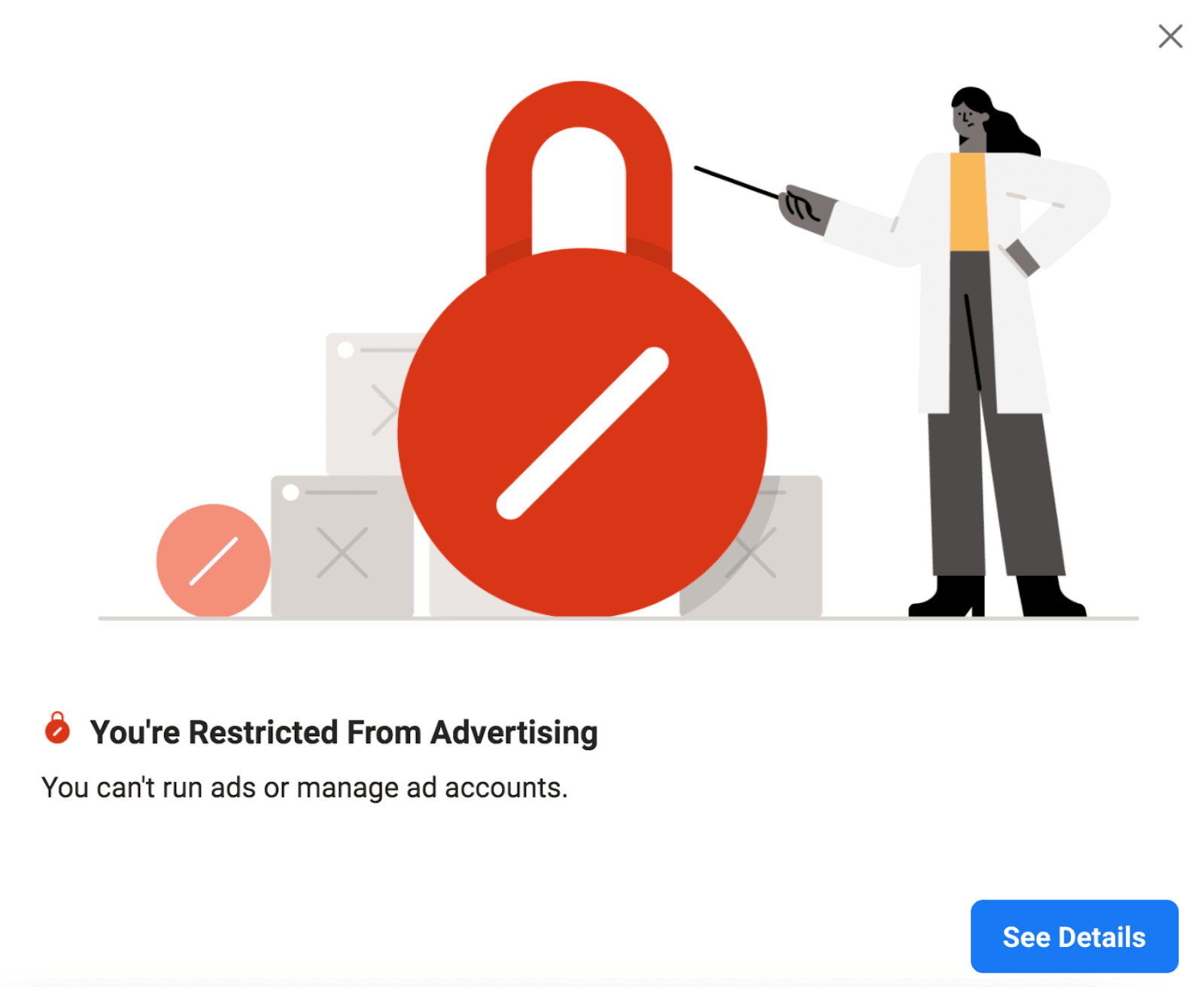
That is why ad account security is not about “how to avoid one single ban.” It is about building a launch system where the number of reasons for a ban is significantly reduced.
1. Do not make sharp moves at the start
One of the most common mistakes is an overly aggressive start. A new account, or even an already active one, reacts poorly to chaotic actions: sudden GEO changes, instant launches with large budgets, mass campaign creation, constant edits in the first few hours, and random setting changes. For algorithms, this does not look like normal advertiser behavior. It looks unstable and risky.
A step-by-step approach is safer. First comes basic activity, then a careful launch, and only after that gradual scaling. The more natural the account behavior looks, the lower the chance that the system will flag it as suspicious.
2. Monitor not only the account, but the entire setup
An ad account by itself solves almost nothing. It is always connected to the domain, the page, the payment infrastructure, analytics, the tracker, redirects, and the traffic handling logic. If there are weak points anywhere in that chain, sooner or later they start affecting the account itself.
For example, the ad may promise one thing, the pre-landing page may say something else, and the final display logic may not match the first touchpoint at all. For moderation systems and automated checks, that looks like a red flag. The same applies to the technical side: questionable redirects, poorly structured domains, sloppy transitions between pages, and a lack of control over incoming traffic quickly increase the risk of restrictions.
3. Control traffic quality instead of just pushing traffic
One of the most underestimated sources of problems is the incoming traffic itself. The flow includes not only real users, but also moderators, automated checks, bots, and irrelevant visits. If an advertiser does not filter these segments in any way, they are effectively leaving their infrastructure open to unnecessary exposure and inspection.
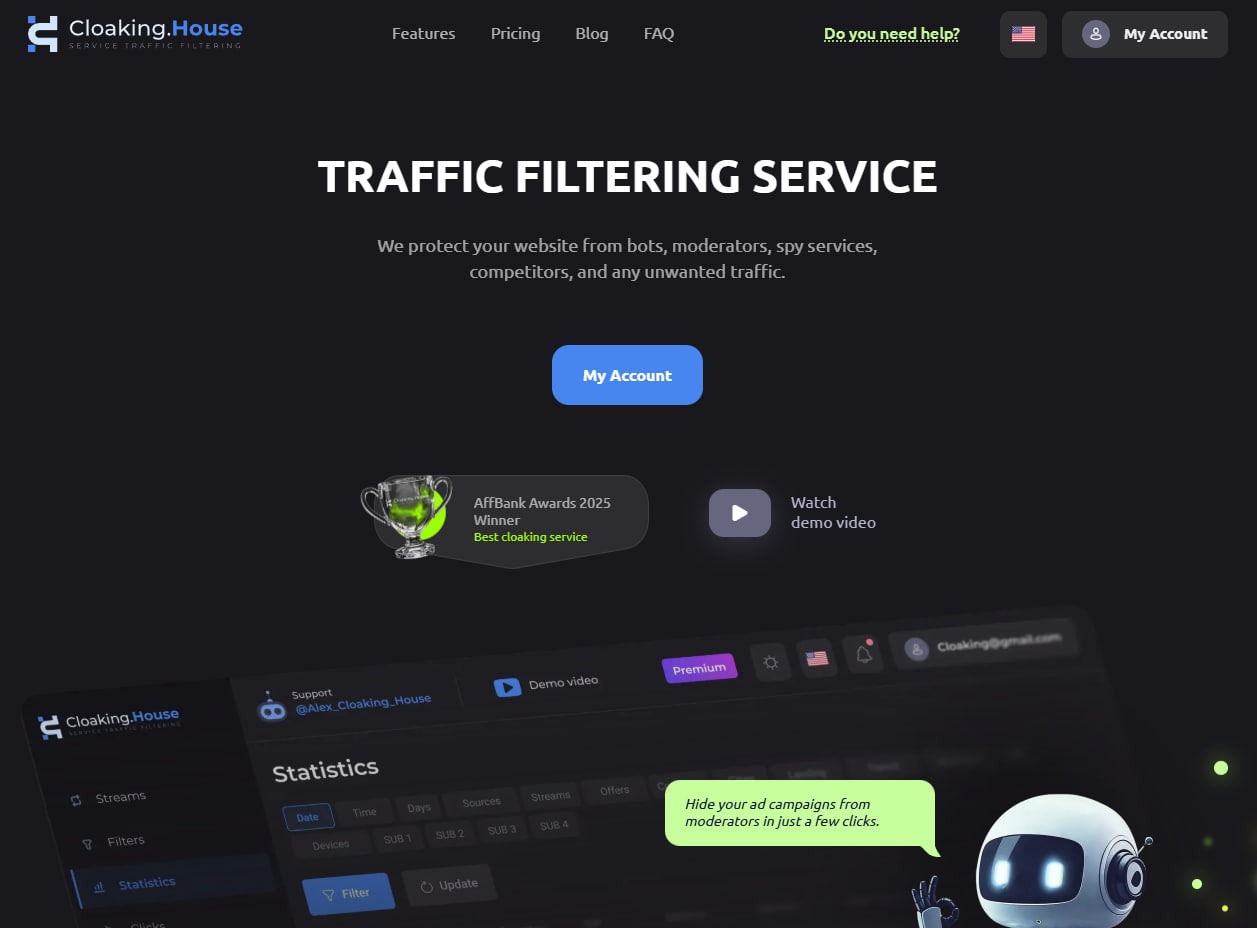
That is why teams that work systematically increasingly rely on dedicated traffic filtering and routing solutions. One of these services is Cloaking House. The platform uses AI-based filtering powered by machine learning: the system analyzes behavior, network parameters, and request signatures to identify ad platform moderators, automated checks, and irrelevant traffic.
Put simply, the purpose of such tools is to prevent unnecessary traffic from damaging the setup. The cleaner the traffic flow, the calmer and more stable the advertising infrastructure works.
4. Use flexible filters instead of relying on luck
As the number of launches grows, manual control is no longer enough. This is especially true if a team is working with multiple offers, domains, GEOs, and traffic sources. At that point, security stops being a matter of one buyer’s experience and becomes a matter of having a manageable system.
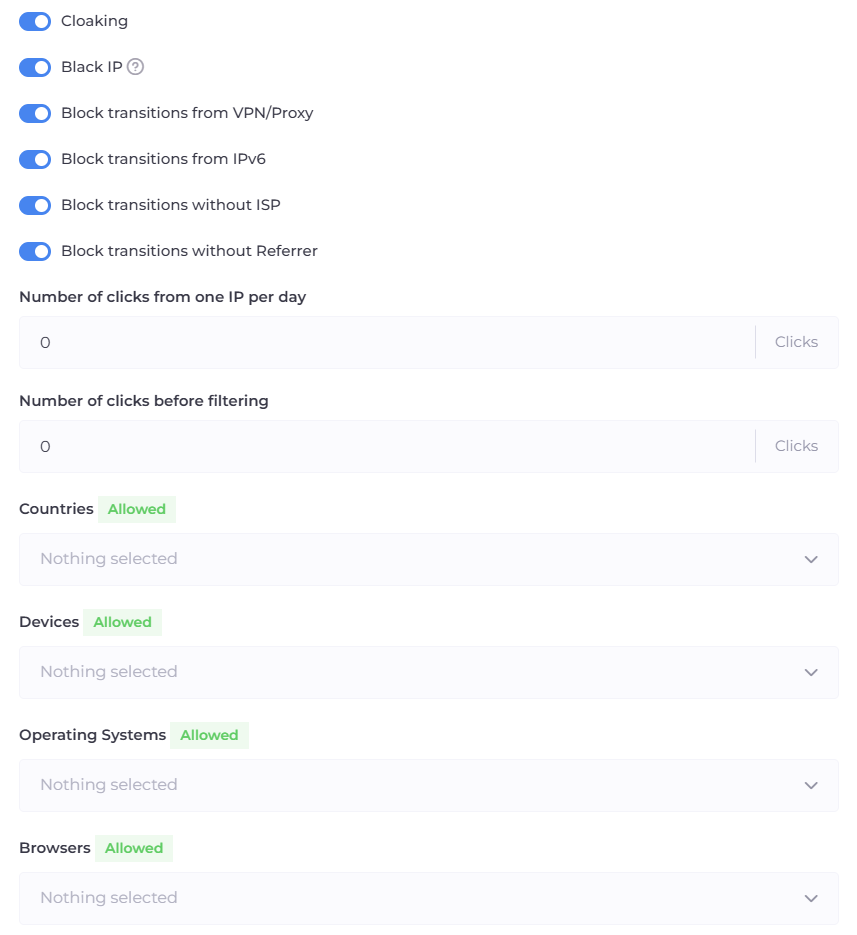
Cloaking House places strong emphasis on flexible traffic management: filtering is available by country, device, operating system, browser, and language. You can also separately restrict traffic with no referer, traffic from unknown providers, and build whitelists and blacklists by IP, ISP, and User-Agent.
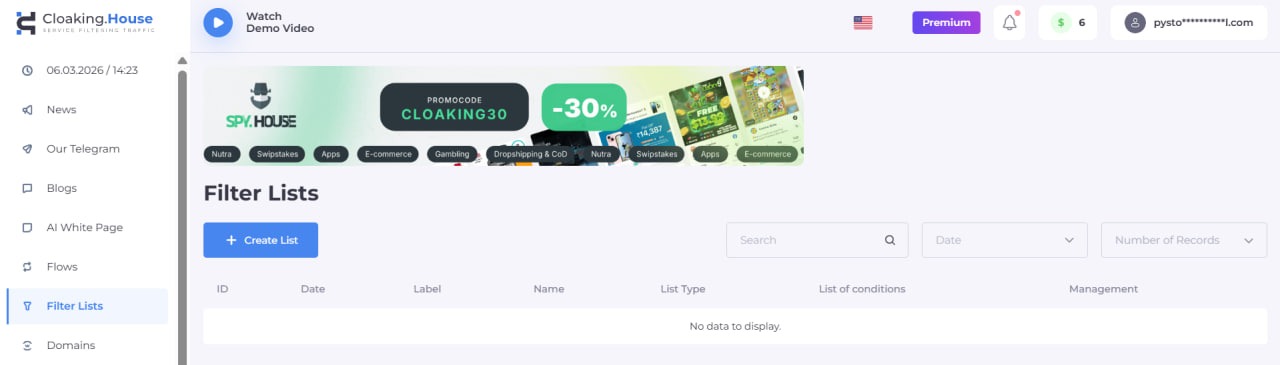
This matters because bans often happen not because of a “bad offer,” but because the wrong type of traffic enters the funnel in the wrong form.
5. Always see what is happening after launch
One of the weakest strategies is to start investigating only after a ban happens. That approach is always more expensive. It is far more useful to monitor the situation while the campaign is running: how much traffic came in, what share was filtered out, which rules were triggered, and which segments started behaving abnormally.
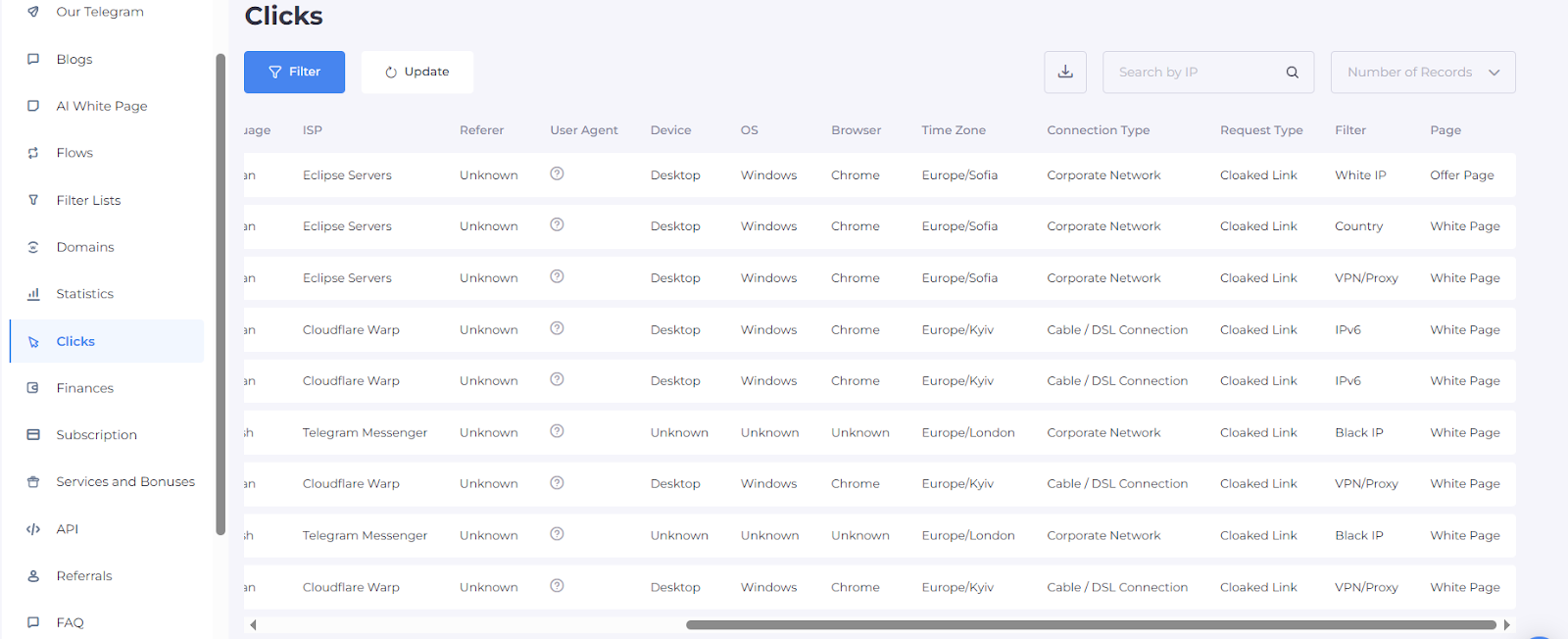
Cloaking House includes analytics inside the dashboard, allowing teams to see how much traffic was filtered, which filters were triggered, and where the traffic came from.
This helps teams do more than just “use the service.” It helps them understand exactly where the weak point in the setup is and what needs to be fixed before the platform applies restrictions.
6. Simplify the technical side of launching
The more complex and confusing the system is, the greater the chance that it will break at the worst possible moment. In advertising, this is especially critical: one extra infrastructure mistake can easily become a trigger for a review or a ban.
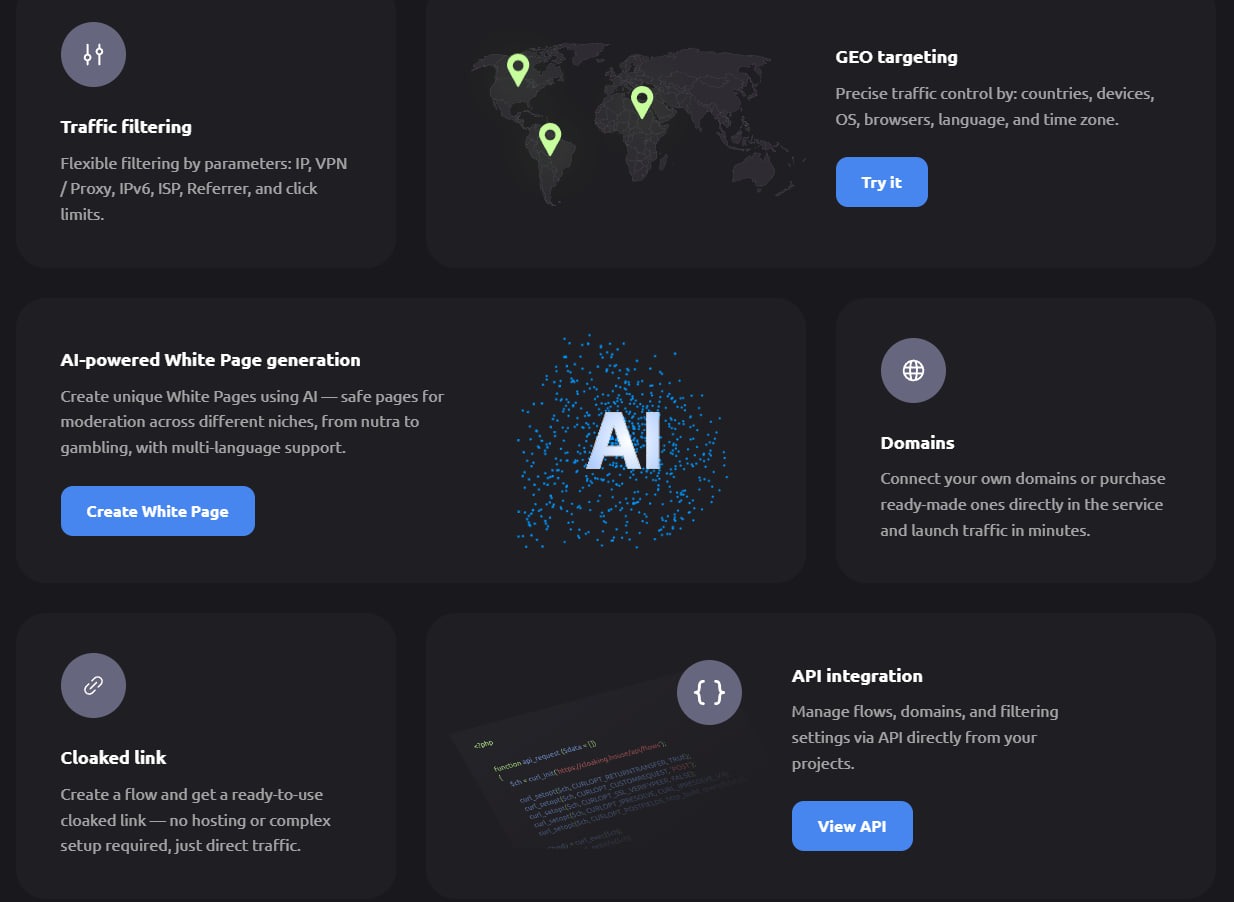
That is why a good technical solution should not only protect the setup, but also avoid making the launch process more complicated. One of Cloaking House’s strengths is that the initial setup is relatively simple: you can upload a PHP file to the park of the domain, use a safe link through a parked domain, and configure the traffic flow without a heavy multi-step build. The service also includes white-page generation based on niche, topic, and offer language, as well as API access for integration into a team’s internal processes.
This reduces the number of manual errors and, as a result, lowers the number of reasons for extra attention from the advertising platform.
7. Understand that account security is not just one setting
Many people still think about ad account protection too narrowly. As if there were one setting, one anti-ban method, or one technical trick that solves everything. In reality, security is a combination of discipline, launch logic, traffic quality, clean infrastructure, and constant control.

That is why services like Cloaking House are useful not as some “clever trick,” but as part of a real working system. The platform supports Google Ads, Meta, TikTok, and other traffic sources, making it convenient for teams running campaigns across multiple channels and wanting to manage traffic from one place.
The combined use of Cloaking House and SimplyNode proxies helps reduce the risk of account bans through two layers of protection: Cloaking House filters and routes traffic, screening out moderators, bots, and irrelevant requests based on multiple parameters, including IP, ISP, User-Agent, GEO, language, and device, while SimplyNode provides a more stable and cleaner proxy infrastructure, making incoming traffic look less suspicious and more natural to advertising platforms. Together, this setup not only allows for more accurate separation of real audiences and platform checks, but also creates a cleaner technical environment for launches, with fewer anomalies, fewer sharp risk signals, and fewer reasons for automatic restrictions from ad platforms.
What actually helps reduce the risk of bans
If you strip everything down to the essentials, safe ad account operation is built on several simple principles.
First, do not overload the account at launch or provoke the platform with chaotic behavior. Second, keep the entire infrastructure in order, not just the ad account itself. Third, control incoming traffic and filter out unnecessary segments before they start damaging the setup. And finally, use tools that provide not only filtering, but also analytics, flexible traffic-handling rules, and a clear technical logic.
In this context, Cloaking House looks like a practical solution for teams that do not want to keep putting out fires after every ban, but instead want to build a more stable and manageable launch system. The service combines AI-based filtering, flexible settings, analytics, white-page generation, and integration capabilities, making it not just a supporting tool, but part of the everyday traffic infrastructure.
In the end, an ad account becomes more stable not when you look for a “secret way to bypass bans”, but when you build your launches carefully, consistently, and with solid technical logic. And the sooner this becomes a system, the less money and time you will spend constantly recovering from bans.
%20-%202026-06-17T113531.915.png)
%20-%202026-06-16T123809.066.png)
%20-%202026-06-15T133620.968.png)
%20-%202026-06-11T124204.649.png)
%20-%202026-06-10T120906.406.png)
%20-%202026-06-09T114737.131.png)
%20-%202026-06-08T110438.827.png)
%20-%202026-06-04T110016.186.png)
%20-%202026-06-03T124454.490.png)
%20-%202026-06-02T162621.296.png)
%20-%202026-06-01T110047.512.png)
%20-%202026-05-29T113134.620.png)
%20-%202026-05-28T123409.485.png)
%20-%202026-05-27T175112.286.png)
%20-%202026-05-26T134040.303.png)
%20-%202026-05-21T164357.956.png)
%20-%202026-05-21T162719.912.png)
%20-%202026-05-19T120136.626.png)
%20-%202026-05-18T110557.344.png)
%20-%202026-05-15T113858.229.png)
%20-%202026-05-14T121851.922.png)
%20-%202026-05-13T120005.619.png)
%20-%202026-05-12T112504.017.png)
%20-%202026-05-11T112454.822.png)
%20-%202026-05-07T105244.165.png)
%20-%202026-05-05T121326.455.png)
%20-%202026-04-30T132926.682.png)
%20-%202026-04-29T122656.668.png)
%20-%202026-04-28T165006.557.png)
%20-%202026-04-27T151422.596.png)
%20-%202026-04-24T134808.219.png)
%20-%202026-04-23T131230.882.png)
%20-%202026-04-22T111352.506.png)
%20-%202026-04-21T115725.855.png)
%20-%202026-04-20T131158.661.png)
%20-%202026-04-10T112244.119.png)
%20-%202026-04-09T111424.150.png)
%20-%202026-04-08T130405.235.png)
%20-%202026-04-07T113530.055.png)
%20-%202026-04-06T113015.908.png)
%20-%202026-04-02T120940.360.png)
%20-%202026-04-01T144424.516.png)
%20-%202026-03-30T112807.229.png)
%20-%202026-03-26T160000.403.png)
%20-%202026-03-26T113412.170.png)
%20-%202026-03-25T110333.022.png)
%20-%202026-03-23T125824.589.png)
%20-%202026-03-19T114712.472.png)
%20-%202026-03-18T142314.362.png)
%20-%202026-03-17T135837.094.png)
%20-%202026-03-16T113750.118.png)
%20-%202026-03-13T134616.799.png)
%20-%202026-03-11T133856.227.png)
%20-%202026-03-10T124412.864.png)
%20(100).png)
%20(99).png)
%20(98).png)
%20(97).png)
%20(96).png)
%20(95).png)
%20(94).png)
%20(93).png)
%20(92).png)
%20(91).png)
%20(90).png)
%20(90).png)
%20(89).png)
%20(88).png)
%20(87).png)
%20(86).png)
%20(85).png)
%20(84).png)
%20(83).png)
%20(82).png)
%20(81).png)
%20(80).png)
%20(79).png)
%20(78).png)
%20(77).png)
%20(76).png)
%20(75).png)
%20(74).png)
%20(73).png)
.png)
.png)
.png)
.png)
.png)
%20(72).png)
%20(70).png)
%20(68).png)
%20(66).png)
%20(64).png)
%20(63).png)
%20(62).png)
%20(60).png)
%20(59).png)
%20(58).png)
